

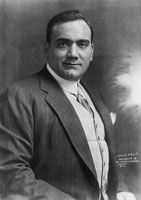
Leonid Sobinov
Born: June 7 1872 Died: October 14, 1934
Leonid Sobinov was born into the family of the lower-middle-class trade officer Vitaly Vasilyevich Sobinov. The period of his childhood was apparently happy and calm. Sobinov's mother, who died early, was a keen singer, and due to her inspiration, he began singing himself. Sobinov enrolled in a university course in Moscow. This led to a degree in law, which he received in 1894. Sobinov would go on to appear in Moscow and St Petersburg in operas such as Ruslan and Ludmila, Faust, Manon, Prince Igor, Eugene Onegin, Halka, Rigoletto, Lohengrin, Tannhäuser (as Walter von der Vogelweide) and Ivanov's Zabava Putyatishna (Solovey Budomirovich). Sobinov was impressed by the up-and-coming operatic bass Feodor Chaliapin, who was one year younger than him, and they appeared together on stage in 1899. In that same year he added the parts of Andrej (Mazeppa), Gérald (Lakmé) and Germont (La traviata) to his repertoire. After going through the score of Carmen, he declined to take on the role of Don Jose, insisting that its dramatic nature would be too taxing for his voice. The reigning lyric tenor at the Bolshoi during the 1890s and early 1900s was Nikolai Figner (1857-1918). Figner was a close friend of Russia's leading composer, Pyotr Tchaikovsky; but Sobinov proved to be the older tenor's equal or superior in every way, surpassing him even as Lensky in Tchaikovsky's Eugene Onegin. In order to enlarge his operatic repertoire (having already added to it the tenor leads in Martha, Werther, Mignon and Roméo et Juliette), Sobinov decided to travel to Italy, so that he could experience Italian opera directly. In 1904-06 (and again in 1911) he appeared at Italy's premier opera house, La Scala, Milan. His performances were acclaimed not only in Russia but also in other European countries, owing to the beauty of his voice and the polish of his singing style. As well as the Bolshoi and La Scala, he sang at the: Mariinsky Theatre, St Petersburg; Sobinov achieved enormous fame despite facing strong competition for the Russian public's affection from a number of rival male singers of outstanding quality. They included his fellow lyric tenors Dmitry Smirnov (1882-1944) and Andrei Labinsky (1871-1941), the spinto tenor Lev Klementiev (1868-1910) and the dramatic tenor Ivan Yershov (1867-1943). According to his contemporaries, Leonid Sobinov was a person blessed with rare charm. He loved a lot and he was loved by a lot. Famous beauties of his era were constantly falling in love with him. They included, among many others, Elisabeth Sadovskaya, the actress, and Vera Karalli, the ballet dancer and silent-cinema star.
In 1917, after the Russian Revolution, Sobinov became the first elected director of the Bolshoi Theatre. He undertook a theatrical trip to the Ukraine in 1918 and found himself cut off temporarily from Russia. In 1919, he was assigned to the role of chairman of the musical committee of the all-Ukrainian Division of Arts in Kiev. The year 1920 saw him become a manager at the Division of Public Education in Sevastopol. In 1920 his son Yuri, who served in the White Army, was killed near Militopol. His other son, Boris, a music composer, (1895-1956), emigrated to Germany. Sobinov again became a director of the Bolshoi Theatre in 1921. Two years later he was selected to be a deputy of the Moscow City Council. He made his last stage appearance in 1933 at a Bolshoi gala held in his honour. The next year, he began work at the operatic studio of Konstantin Stanislavsky as the studio's artistic leader. On the night of 14 October 1934, Sobinov died in Riga's Hotel Saint Petersburg from a heart attack. His death was instantaneous, and he passed away in his sleep. His body was transported back to Moscow by special train. He was buried on 19 October at the Novo-Devichy Cemetery in Moscow. |
Listen | |||||
| Scene | Listen | Aria | Opera | Date | Time |
| 46a | Narrative, Sobinov | 2.09 | |||
| 46b | Sobinov, Whither have you gone | E/ Onegin | 1910 | 3.05 | |
| 47a | Narrative, Sobinov | 1.36 | |||
| 47b | Sobinov, Hai Compreso w Neshdanova | P/Fishers | 1910 | 3.30 | |
| 48a | Narrative, | 2.08 | |||
| 48b | Sobinov, Giunto Sul Passo | Mefistofele | 1910 | 3.05 | |
| 49a | Narrative, Sobinov | 2.58 | |||
| 49b | Sobinov, Cigno Fedel (Swan) | Lonhengrin | 1910 | 4.00 | |
| 50a | Narrative, Sobinov | 7.20 | |||
| 50b | Sobinov, Cavatina | Russalka | 1910 | 4.20 | |
Home
About Us
Contact Us
Signup

