

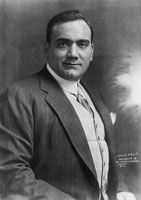
Mario Lanza
![]() Lanza, MarioBorn: 31 January 1921 Died: 7 October 1959
American tenor. At the age of sixteen, to his parents' great delight, he announced his intention to become a singer. His mother saw the realisation of her own dreams through her son's ambition and made every sacrifice to enable him to attend the singing lessons he needed. He was discovered by the conductor Serge Koussevitsky, who was so impressed with his singing that he granted him a scholarship to his Berkshire Music School. He made his debut at the Berkshire Music Festival in 1942 as Fenton in " The Merry Wives of Windsor", changing his name to Mario Lanza as a tribute to his mother. But, just as his career was starting to take off, it was abruptly interrupted by conscription into the US army. Enrico Rosati said that Mario Lanza had one of the most beautiful voices he had ever heard . He also said that he had an exuberant character, but also that he was very generous and amiable with a great heart, which was evident in the way that he sang. Between October 1945 and February 1946, Lanza appeared in six programmes of "Great Moments In Music" in New York, singing arias such as the love duet from Verdi's "Otello". In July 1947, he formed the Bel Canto Trio with Frances Yeend, soprano and George London, baritone. In eleven months, the trio gave 84 concerts across the United States, Canada and Mexico. In the meantime, Lanza had made his debut at the New Orleans Opera House as Pinkerton in Puccini's "Madame Butterfly". His 200th concert appearance was in the open air at the Hollywood Bowl on the 28 August 1947, a day that was to change his whole future career. MGM chief Louis B Mayer heard him and a seven year contract was soon signed. Among Mario Lanza's many films were "That Midnight Kiss" (MGM 1949) and "The Toast of New Orleans" (MGM 1950), which included the song "Be My Love" , his first gold record. His greatest film success, The Great Caruso" (MGM 1951) made him world famous. He made a legendary US " Caruso Concert Tour" in 1951 and " Lanza Fever" swept the whole of America. "Because You're Mine" (MGM 1952) was selected for the Royal Command Film Performance in Britain. Between June 1951 and July 1952, his radio programme "The Coca Cola Show" proved extremely popular. Songs from these shows are still being released. For the film The Student Prince}{ (MGM 1954), he made the recording two years before the film was released. "Serenade" (Warner Brothers 1955), his last film made in America, provided a vehicle for his great dramatic talent. In May 1957, Mario Lanza moved with his family to Rome where he made two further films " The Seven Hills of Rome" (MGM /Titanus 1957) and "For The First Time" (MGM/CCC1958). Whereas in 1949, he had felt that his voice was too immature to open the season at "La Scala" or to join the Metropolitan Opera in New York, he now felt that his voice had matured and was ready for the opera stage. First, it is said that arrangements were made to complete studio performances of the great operas with Maria Callas. Lanza then made extended concert tours in Europe, starting in November in England with the Royal Command Performance, followed by nation-wide tours including the Royal Albert Hall, Birmingham and Sheffield Concerts. He sang in Belgium, Holland, France and Germany. His very last concert was on 13 April in Kiel, Germany, where his voice was "darker and richer, and he sang as never before" as his pianist Callinicos recalled. In the "Triumph March" for the final scene of "For The First Time" he oversang the 260 member Rome Opera House orchestra and chorus. The General Director Ricardo Vitale was deeply impressed and in August 1958 Mario accepted his invitation to open the Rome Opera season in 1960 with "Tosca" . Mario Lanza was full of plans and activities. His itinerary for 1960 was already filling up with plans to sing in South Africa, Hungary and Russia. In June 1959 he signed another film contact - "Laugh Clown Laugh" and made several recordings, the very last on 10 September 1959 "The Lord's Prayer" which was never released. |
Listen | ||||||
| Scene | Listen | Tenor | Aria | Opera | Date | Time |
| n18-32 | Mario Lanza Narrative | |||||
| a18-33 | Lanza | Drinking Song | S/Prince | 19xx | 3.18 | |
| a18-34 | Lanza | I'll Walk With God | S/ Prince | 19xx | 2.55 | |
| Narrative Ammendments | ||||||
| Mario Lanza was born in 1921 of Italian decent. He sang two performances of Madame Butterfly with the New Orleans Opera Company. | ||||||
Home
About Us
Contact Us
Signup
